


In a previous article, we highlighted the essential role of DHA during pregnancy and its importance in supporting the normal infant development. This essential polyunsaturated fatty acid remains just as important afterbirth, contributing to healthy growth and cognitive development throughout childhood. Insufficient DHA intake has been associated with learning difficulties and may also be involved in attention-related challenges. In adults as well, DHA promotes cognitive ability and concentration and appears to have a positive impact on mental health.
Children’s development and learning
DHA plays a role in membrane fluidity and neurotransmitter release in nervous tissue, particularly in the brain, where it is the most abundant polyunsaturated fatty acid (PUFA), accounting for 15-20% of total fatty acids in the frontal areas involved in learning, behaviour and personality.
Research indicates that DHA supplementation has an effect on children’s psychosocial functioning, emotional balance and ability to maintain focused attention. Omega-3 intake has been shown to correlate with certain cognitive test scores, especially in girls (1), and studies report measurable changes in brain activity during sustained-attention tasks following DHA concentration (2). Evidence from animals also suggests that insufficient DHA during growth and maturation may influence brain function in adulthood (3) .
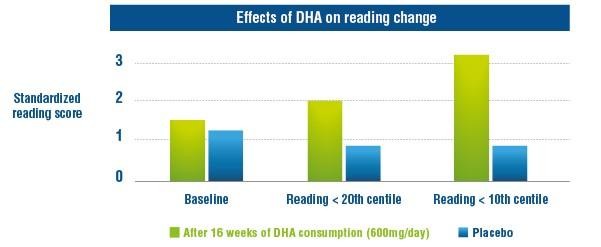
It is those with the lowest intake who benefit the most from supplementation. In a study conducted in England, daily supplementation with 600 mg of DHA improved reading performance in 224 children whose initial scores were among the lowest 20%, with an even greater improvement observed in those within the lowest 10% (4). Additional studies suggest that higher DHA intake may support healthier sleep patterns in children, which in turn can aid with learning capacity (5,6).
Attention deficit and hyperactivity disorders (ADHD)
Attention Deficit Hyperactivity Disorder (ADHD) is a complex condition with multiple potential contributing factors, varied symptoms and heterogeneous responses to treatment. Standard care for young people typically combines pharmacological (i.e. drug based) and psychological interventions, while interest has grown in complementary, non-pharmacological strategies such as omega-3 supplementation for for their potential role as alternative or additive approaches (7). DHA is present in the brain at levels several hundred times higher than EPA and plays a key role in brain functions, making it a relevant candidate for research into ADHD management (8) .
A meta-analysis by Chang et al. (9), which reviewed 7 studies involving a total of 534 young people with ADHD, reported that PUFA supplementation may support improvements in both clinical symptoms and cognitive performance in children and teenagers.
In addition, a 6-month study involving 50 participants aged 7 to 14 years showed that DHA supplementation was associated with improvements in psychosocial functioning, emotional difficulties and focused attention, with differences between the DHA and placebo groups, becoming apparent after just 3 months(7).
DHA supplementation improves circulating DHA and EPA
While the human body can convert dietary Eicosapentaenoic acid (EPA)t into DHA, the reverse does not occur. Studies have consistently shown that supplementing with DHA raises the circulating levels of both DHA and EPA.(10,11). This effect is likely due to a reduced need for the body to convert dietary EPA into DHA (12). Therefore, increasing DHA intake through supplementation can support the balance of these essential fatty acids, which play complementary roles in maintaining overall health.
Mental Wellness
Depression and anxiety are among the most prevalent mental health disorders, affecting over 10% of the population and accounting for over 10% of the global disease burden. According to the WHO, major depression has historically been the leading cause of disability worldwide (13). Despite the availability of numerous medications prescribed for depression, 19% to 34% of patients don’t respond to first-line treatments (8). Other illnesses such as schizophrenia, bipolar disorder and eating disorders, can also have significant long-term impacts on wellbeing.
Nutrition plays a key role in mental wellbeing. Research has shown correlations between national rates of depression and apparent fish consumption (14), although cultural, economic and social factors influence outcomes. Beyond conventional treatments, clinical studies increasingly explore how nutritional supplementation, including polyunsaturated fatty acids (PUFAs), vitamins, minerals, antioxidants, amino acids and pre/probiotics, can help preserve mental wellness (8).
Many studies have noted the low DHA levels in brain or blood of individuals with depression or anxiety (15, 16). Current evidence suggests that omega-3 supplementation can have a positive impact on progression or severity of mental disorders across all age groups, from children and adolescents (17) , adults (8) and the over-60s (18) .
Regular DHA supplementation, from childhood to senior age, has the potential to improve mental function, improving attention and learning performance. It may also positively impact overall mental health and quality of life.
While many of these benefits are attributed to DHA’s role in the membranes of nervous tissues, especially in the brain, studies indicates that some effects may also stem from its influence on the gut microbiota, microorganisms that play a more significant role in our health than previously recognized.
We will explore how DHA shapes gut microbiota and the implications this has for mental and overall health.
Bibliopraphy :
14. Hibbeln, J. R. Fish consumption and major depression. Lancet Lond. Engl. 351, 1213 (1998).