
.png)

As we age, our bodies undergo natural physiological changes, especially in organs such as the brain, eyes, cardiovascular system and skin. Omega-3s from sustainable microalgae contribute to maintaining and operating these organs, while respecting the planet.
Omega-3 & Cognition
Aging and cognitive decline
The brain, like other organs, experiences cellular aging that gradually reduces cognitive abilities. After reaching peak performance between 18 and 25 years, functional capacity gradually declines [1, 2], with signs of cognitive decline often appearing around age 45 [1].
Typical changes associated with physiological aging involve:
- A decrease in memory efficiency,
- A reduced attention,
- Potential language difficulties,
- A more fragile executive functions [2].
Age is also a major risk factor for neurodegenerative diseases such as Alzheimer’s, affecting over 20% of people above 80 years old compared to 3% for those over 65 [3]. Consuming omega-3 dietary supplements from sustainable, plant-based sources can be a practical way to provide these essential fatty acids.
Omega-3 to slow down brain aging
The brain is the 2nd most lipid-rich tissue (50%)[4], and its neuron membranes contains specific fatty acids, including omega-3s. Docosahexaenoic acid (DHA) is the most abundant omega-3 fatty acid in the brain[5].
Unlike adipose tissue, these fatty acids have structural and functional roles, helping maintain neuron fluidity and integrity. DHA is a major component of cell membranes, supporting neurotransmitter release and membrane renewal [6].
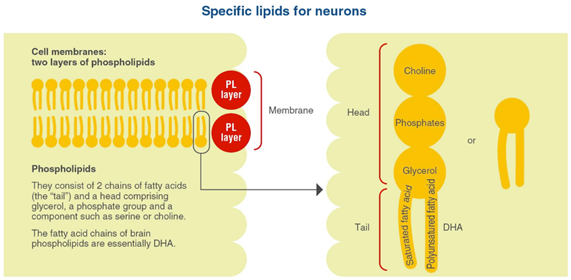
The importance of brain lipids, particularly omega-3s, has been demonstrated in several studies. Research highlights an association between low blood levels of omega-3 and the occurrence of neurological conditions with an inflammatory component [8]. Altered lipid distribution in brain cells has been linked to the development of such neurological conditions [9].
To support normal brain function, a daily intake of at least 250 mg/g of DHA/EPA is recommended, either through diet or dietary supplements. This intake helps maintain an optimal lipid composition [10,11].
Omega-3 & Cardiovascular system

Cardiovascular disease
Cardiovascular disease is the leading cause of death globally, with over 17.7 million deaths annually. It represents a real global public health challenge. [12]
The etiology of these conditions is multifactorial, but several risk factors increase the likelihood of their occurrence. Age is a major factor, with the probability of a cardiovascular event rising after 50 years in men and 60 years in women [13].
High levels of triglycerides and LDL-cholesterol are also associated with an increased risk, and dyslipidemia is particularly prevalent in adults aged 55 to 74 (67% in men) [14,15].
Nevertheless, a balanced diet, that includes foods rich in omega-3s represents a protective factor for these pathologies [16,17] and provides a nutritional factor for long-term wellbeing.
Omega-3 for a healthy cardiovascular system
Long chain omega-3, particularly DHA and EPA, are associated with cardiovascular health benefits.
A 2020 meta-analysis published in the Mayo Clinic Proceedings highlights the potential role of DHA and EPA in reducing the risk of myocardial infarction, heart attack and mortality related to cardiovascular disease [18]. This study, based on randomized controlled trials, observed a significant reduction in certain risk factors, such as dyslipidemia, among high-risk populations consuming these omega-3s [18].
Do you know the health claims for Omega-3?
- "DHA helps maintain a normal concentration of triglycerides in the blood"
- "EPA and DHA help maintain normal blood pressure"
- "EPA and DHA help maintain a normal concentration of triglycerides in the blood"
- "EPA and DHA contribute to normal cardiac function"
Omega-3 & Vision

Age-related eyesight changes
As one of our essential senses, vision naturally evolves over time. With aging, ocular tissues become more vulnerable, increasing the likelihood of conditions such as macular degeneration, glaucoma, or dry eye syndrome. Macular degeneration, which typically appears after the age of 50, results from the gradual deterioration of the macula, the area of the retina responsible for sharp, central vision [19,20].
The second leading cause of blindness in France is glaucoma, affecting 1-2% of adults aged over 40 and approximately 10% of those over 70. This chronic condition is linked to the progressive damage of optic nerve fibers, often associated with elevated. intraocular pressure, leading to loss of visual field over time [21].
Dry eye syndrome, affecting about 15% of people over 60, is also common. As tear gland function decreases with age, tear production and quality decline, which can result in corneal irritation and increased susceptibility to eye infections [22].
Although changes in vision are part of natural aging, they are unavoidable. A balanced diet can help maintain eye health over time. Nutrients such as carotenoids, lutein and omega-3s have been studied for their role in supporting visual function [23]. Choosing sustainable, plant-based omega-3 sources — including DHA-rich microalgae — is one way to help meet daily intake recommendations while supporting ocean preservation.
Omega-3 and eye health
The retina contains the highest concentration of DHA in the body, making this omega-3 fatty acid essential for the structure and function of photoreceptor cells involved in vision. The claim that “docosahexaenoic acid contributes to maintaining normal vision” can be obtained provided that the foodstuff contains at least 40 mg of DHA per 100 g and per 100 kcal. Consuming at least 250 mg of DHA per day, whether through diet or supplements, helps maintain normal vision [23].
Long-chain omega-3s also provide long-term benefits for eye health. [24]. Studies indicate potential benefits in managing dry eye syndrome by stabilizing the tear film and reducing ocular surface inflammation [24].
High DHA intake is associated with a lower risk of age-related macular degeneration [24, 25], and observational studies suggest a protective role against glaucoma [26,27]. Finally, the consumption of omega-3 fatty acids is presented as a protective factor against glaucoma by several observational studies [26,27].
These benefits are thought to arise from the antioxidant properties of omega-3, which are useful in the fight against oxidative stress, as well as the damage associated with inflammation present in these neurodegenerative ocular pathologies [25]. Choosing DHA from sustainable, high-purity microalgae supports both long-term eye health and environmental responsibility.
Omega-3 & Skin

Skin aging
Skin aging processes are implemented from early adulthood [28].
Skin aging begins in early adulthood and is influenced by both intrinsic and extrinsic factors. Intrinsic factors, linked to natural aging and genetics, are unavoidable, while factors such as UV exposure or a unbalanced diet low in antioxidants can accelerate skin aging [29].
As we age, the skin’s natural function declines: hydration decreases, elasticity is reduced, and the skin becomes more fragile. Cell regeneration slows down, and the activity of the sebaceous and sweat glands diminishes. Collagen production also decreases, leading to visible changes as wrinkles, loss of radiance, and, over the long term, a higher susceptibility to skin disorders [30,31,32].
Consuming omega-3 from sustainable, plant-based sources can be part of a nutritional approach to support skin health and overall vitality while aligning with environmental responsibility.
Omega-3 and skincare
Diet plays a key role in slowing the aging process.
Omega-3 fatty acids, thanks to their antioxidant and anti-inflammatory properties, help to combat oxidative stress and mitigate the effects of UV exposure, both of which can damage skin cells. These fatty acids may also provide valuable help in preventing skin disorder [33].
In addition, research highlights the role of EPA in promoting the expression of collagen and elastin fibers, two structural proteins that naturally decline with age [33].
Due to these properties, omega-3 from sustainable, plant-based sources is considered a valuable nutrient capable of preventing signs of aging in skin [34].
FERMENTALG, the vegan Omega-3 specialist
Fermentalg, an expert in microalgae biotechnology, provides sustainable solutions for the food and nutraceutical industries. The DHA ΩRIGINS™ range, derived from the Schizochytrium sp. microalgae, delivers products naturally concentrated in vegan omega-3, available as oils, powder and soft capsules.
Key advantages of DHA ΩRIGINS™:
- Certified vegan Omega-3 from Schizochytrium sp. microalgae suitable for all consumers
- Sustainable sourcing: the "super-producer" strain is harvested only once in its natural environment, preserving biodiversity
- Omega-3 in natural triglycerides form (TG), obtained by a solvent-free extraction process
- High DHA content naturally concentrated without any chemical process or enrichment, providing a minimum of 550 mg/g DHA (as fatty acids)
- Neutral taste and mild organoleptic profile, making it easy to incorporate into formulations
By combining sustainability, quality, and natural concentration, DHA ΩRIGINS™ represents a premium plant-based Omega-3 solution aligned with both consumer expectation and environmental responsibility.
SOURCES
[2] Bernadette Ska et Yves Joanette, 2006, Vieillissement normal et cognition, Med Sci.
[3] Association France Alzheimer, Article “Premiers repères sur la maladie d’Alzheimer”
[4] https://alwaysomega3s.com/why/brain-health
[5] https://www.fatsoflife.com/health-benefits/brain-health-benefits
[6] Communiqué – Salle de presse INSERM, 2014, Des lipides au service du cerveau
[7] https://www.pensersante.fr/acides-gras-et-cerveau-penser-sante
[9] Yu-Chia Kao et al., 2020, Lipids and Alzheimer’s Disease, Int J Mol Sci.
[10] Nutrition Santé, 2006, Article, Vieillesse et modification du métabolisme des AGPI oméga 6 et oméga 3
[13] OMS, 2017, Maladies cardiovasculaires
[14] L’assurance maladie Ameli, 2022, Le risque cardiovasculaire et ses facteurs
[15] J.Ferriers, Service de cardiologie, CHU Rangueil, Toulouse, Revues générales “Le risque cardiovasculaire: Prévalence des différentes dyslipidémies en France”
[16] Fédération Française de Cardiologie, 2021, Ce qu’il faut savoir sur les oméga-3
[17] Blog Nestlé NutriPro, Article “Nutrition et pathologies cardiovasculaires”, 2012
[19] L’assurance maladie Ameli, 2021, Comprendre la dégénérescence maculaire liée à l’âge (DMLA)
[21] L’assurance maladie Ameli, 2022, Comprendre le glaucome
[22] L’assurance maladie Ameli, 2021, Sécheresse oculaire : définition, symptômes et causes
[23] AlwaysOmega3s, Infographie “Nutrition for eye health”
[27] Jae H Kang and al., 2004, Dietary fat consumption adn primary open-angle glaucoma, Am J Clin Nutr.
[28] PharmaFutur, 2018, Les facteurs responsables du vieillissement prématuré de la peau.
[30] Centre de lutte contre le cancer Léon Bérard, Cancer de la peau – Mélanome
[32] Yu Sawada et al., 2020, Omega3 fatty acid and skin diseases, Frontiers in Immunology
[34] Soyun Cho, 2014, The role of functional foods in cutaneous anti-aging, J Lifestyle Med
[35] Institut National du Cancer, 2022, Le mélanome de la peau