
This Fermentalg article highlights how we identify and secure high-quality DHA sources for dietary and nutraceutical applications. Consumers increasingly expect ethical sourcing, clean processes, and environmentally respectful production — expectations that guide each step of our strain selection and process development.
Developing a production procedure
Up-Stream and Down-Stream Processes
Developing an oil ingredient from a high-potential microalgae strain involves both designing an efficient process to produce large quantities of lipid-rich biomass (the Up-Stream Process or USP), and establishing the extraction and purification steps needed to obtain a high-quality edible oil (the Down-Stream Process or DSP).
The USP begins with a small tube of cryopreserved cells that are progressively scaled up, with nutrients provided to support repeated cell doubling, until large quantities of lipid-rich biomass are obtained. These fermentation steps are first developed in benchtop bioreactors with volumes from 1 to 5L.
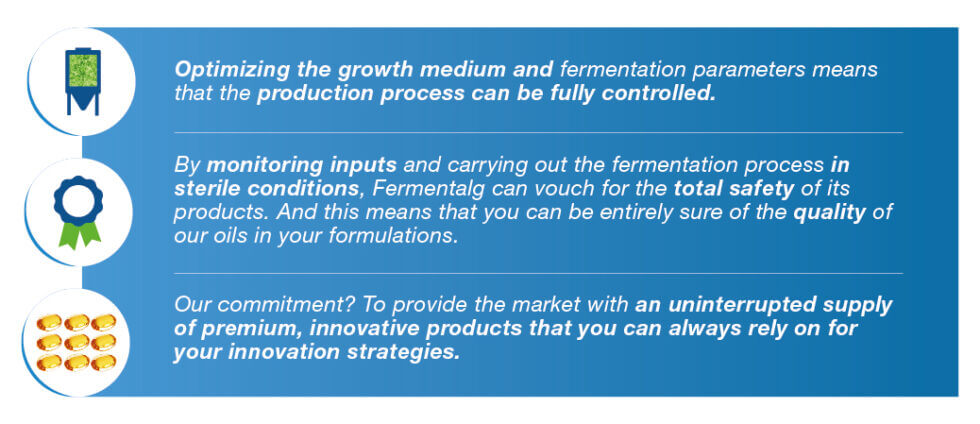
The fermentation [1] process is developed to maximize productivity while ensuring industrial feasibility, and is intrinsically linked to the downstream extraction and purification steps. The quality of the biomass directly influences how efficiently the oils are extracted. This involves optimizing the growth medium to meet the cellular nutritional needs and defining key fermentation parameters (pH, oxygen, temperature, etc.), which together determine both growth rate and final oil yields.
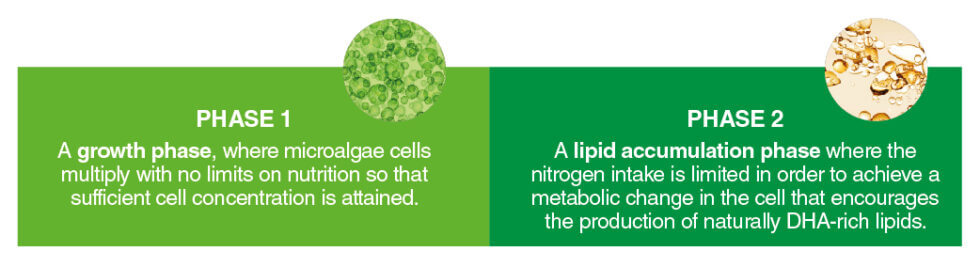
For the procedure developed to produce DHA ORIGINS®, the main fermentation stage is structured into two phases.
Utmost safety of the growth medium
Extraction and purification
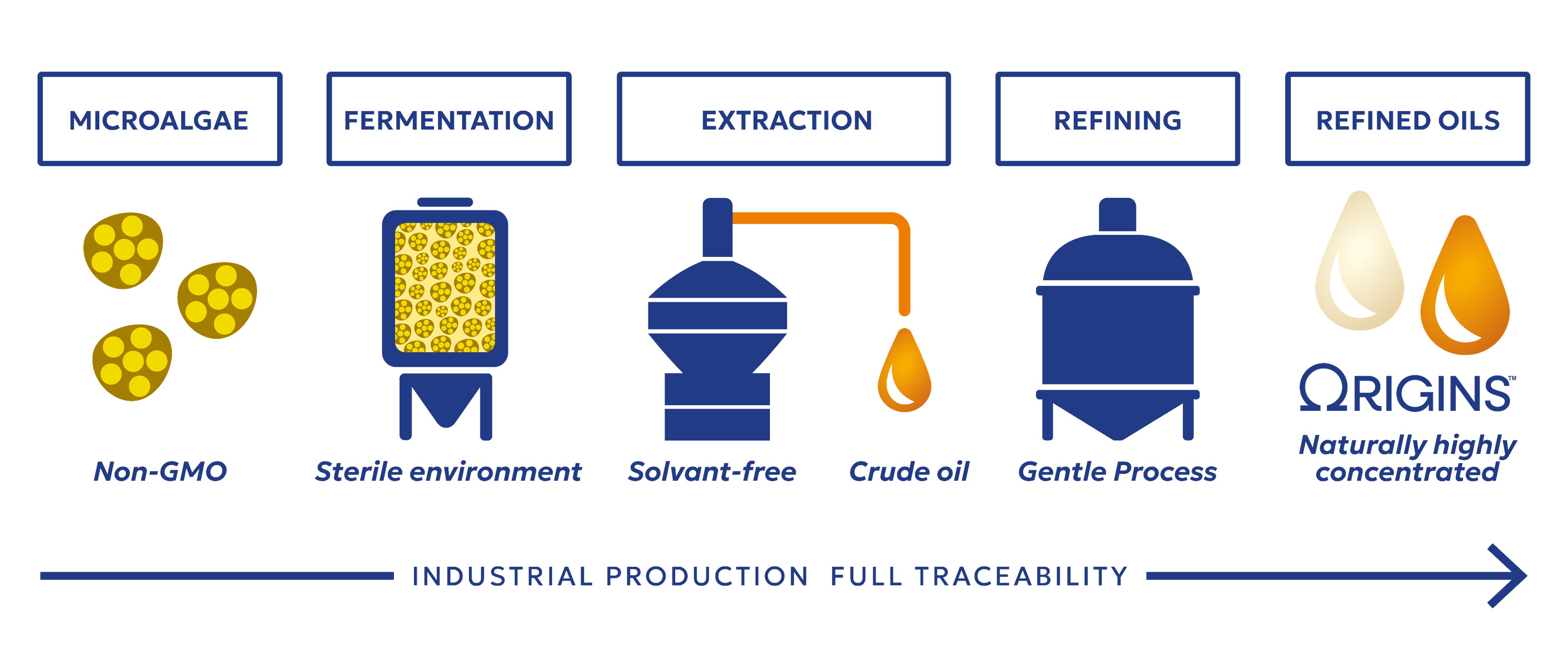
As mentioned above, getting the algae to accumulate lipids is only the first half of the process. The Downstream Process (DSP) is just as essential, as it directly influences the final oil’s quality. Optimizing the extraction and purification processes has required fine-tuning every technical operation used to separate lipids from the cell biomass before gently refining the oils. This involves a sequence of fractionation stages, each of which can influence the next.
The main challenge is to preserve, or even improve, the functional, nutritional, and organoleptic qualities of the oils throughout the extraction and purification[2] steps, while also maximizing yield and reducing waste. Omega-3 fatty acids are valuable yet fragile compounds, highly sensitive to peroxidation, a reaction responsible for all the off-odors often found in fish oils. For this reason, particular care is taken to prevent lipid oxidation at every stage.
We are also highly attentive to the environmental impact of solvent use, as well as to its potential effects on the final product. This is why we have opted for solvent-free processes, even though they may deliver slightly lower yields.
Scale Up to Pilot, and Industrial Transfer
Once sufficiently developed, both upstream and downstream processes are transferred to a higher-volume platform to validate their performance for industrial production. If necessary, adjustments can be made by scaling down and correcting any observed deviations.
Three main activities are conducted in the pilot unit:
• Further development of fermentation, extraction, and purification procedures
• Validation, including scale-up and production support
• Production of representative samples
The development activity builds on previous laboratory-scale work on both USP and DSP. Under the direction of scientific project experts, pilot unit teams perform and coordinate technical operations to achieve the objectives of each test. These operations often involve equipment exclusive to larger scales or greater material volumes, ranging from testing new growth substrates to evaluating the impact of refining parameters on the oils’ colour.
To support eventual industrial transfer or production, the platform can simulate industrial operations to validate and predict procedure performance at large scale and identify potential technical constraints as volumes grow.
For sample production, the platform is structured to comply with standards for their intended use, ensuring food-grade suitability, and applies the same protective measures against oxidation as in full-scale production.
The product life cycle, including the DHA ORIGINS® range, goes through three stages.

Each step is designed to optimize product quality and deliver tangible benefits to clients. The processes are interconnected, with feedback between the teams and continuous improvement to ensure ongoing excellence.
Support activities
Development and production are integrated within a framework that ensures product safety, quality, and client protection. Fermentalg operates several platforms that collaborate closely with the scientific and production teams.
An analytical platform
• To continuously monitor product quality, a team of skilled engineers and technicians performs analyses at every stage of production.
• They systematically measure the fatty acid profile, including omega-3 and omega-6 dosage, in both crude and refined oils.
• They measure indicators of oxidation, microbiology, and heavy metal content to ensure high quality standards throughout production and packaging.
Real-time and accelerated stability studies monitor and predict oil quality over time, ensuring a reliable use-by date.
All analyses are conducted according to validated official methods, guaranteeing trustworthy results. Furthermore, our analytical department supports R&D platforms by improving processes and products and participates in inter-laboratory testing to evaluate performance throughout the year.
Regulatory affairs department
Regulatory requirements vary widely between countries and are often complex. This department ensures full understanding of the regulatory environment and, where needed, manages obtaining, amending, and maintaining marketing authorizations for products in our portfolio.
During new product development, it works closely with R&D teams to ensure that regulatory requirements are correctly interpreted and met. It monitors changes in regulations affecting the product area and communicates updates to the R&D, Marketing, Product, and Analysis teams. The regulatory affairs platform ensures that new products are properly registered, updates existing registrations as required, and supports client-facing teams in responding to regulatory queries.
Quality department
The Quality Department at Fermentalg serves as the ultimate guarantor of product quality. Each batch is validated against internal specifications and relevant regulatory standards for both products and food safety.
Working closely with the Regulatory Affairs Department, the Quality Department updates quality specifications as regulatory and market requirements evolve and ensures that correct processes and procedures are consistently applied across development and production. Fermentalg operates a robust quality and food safety management system, regularly audited for ISO 22000:2018 certification.
Intellectual property unit
Fermentalg values innovation and ensures that its oils and production processes operate freely while protecting its own inventions whenever possible, notably through patents or trade secrets. Fermentalg has a number of patents currently pending for high omega-3 content oils.
In conclusion: Choosing premium, ethical raw materials to meet the high expectations of consumers
In today’s omega-3 market, plant-based oils from microalgae provide a natural health solution due to their naturally high DHA content. They meet consumers' high expectations for ethical sourcing, environmental protection, and animal welfare. Produced above ground using gentle, chemical-free extraction processes, these oils are part of a "clean process" approach that respects this exceptional natural product.
Laboratories experienced in marketing animal-derived omega-3s may face challenges when launching and positioning vegan omega-3 products within their existing range. They may worry that their current business could compete with this alternative option. However, using premium-quality plant-based omega-3 in your formulations opens up new possibilities for:
• Offering consumers a choice of products with excellent organoleptic quality, free from the smell or aftertaste typical of fish oils.
• Attracting new, informed, and conscientious customers (vegan or concerned about allergens, pollution, or other environmental impacts).
• Engaging in the social responsibility of stakeholders in the nutraceuticals sector, helping ensure a sustainable legacy for future generations.
Choosing ethically sourced ingredients also supports environmental protection and future readiness.
Is quality more expensive?
Developing a premium raw material requires investment and can impact market prices. However, the price difference of the raw material has minimal impact on the daily dose cost.
To make the right choice, a laboratory should consider what the consumer values most. Is it product quality and efficacy, origin, traceability and safety, or packaging? Ensure that choices and budget decisions align with consumer expectations. Plant-based omega-3 meets growing consumer demand for sustainability, vegan, and locally sourced options.
The importance of educating consumers on food quality and selecting suitable dietary supplements is clear. To explain this approach, brands must justify the added value of their product. Clarity and transparency are key to maintaining consumer trust, which is why we have developed the DHA ORIGINS® range.
[1] Involves the use of micro-organisms such as microalgae, which are capable of using organic substrates as a source of energy for producing valuable molecules (lipids, proteins, pigments, etc.). The fermentation process is carried out in bioreactors that enable production to be done under carefully controlled conditions and in large volumes, without taking up large expanses of land.
[2] The set of operations used to process the crude oil by removing impurities in order to obtain an oil with satisfactory organoleptic and chemical qualities. Initially, high quality algae oils only require slight deodorization and discoloration processes.