

Purification and preservation of microalgal strains
Microalgae are at the source of premium DHA. The amount and quality of DHA in a final product strongly depend on the microalgal strain used. Some strains naturally produce higher levels of DHA, while others are better suited for industrial cultivation. Understanding the performance of each strain is therefore essential to guarantee premium plant-based DHA for dietary supplements.
Isolating strains
Environmental samples can contain a wide variety of microorganisms, and the challenge is to isolate and purify the best. After incubation at temperatures similar to those in the natural harvesting sites, several colonies developed. some potentially the Thraustochytriaceae (microalgae) that we wanted, others such as fungi or bacteria.
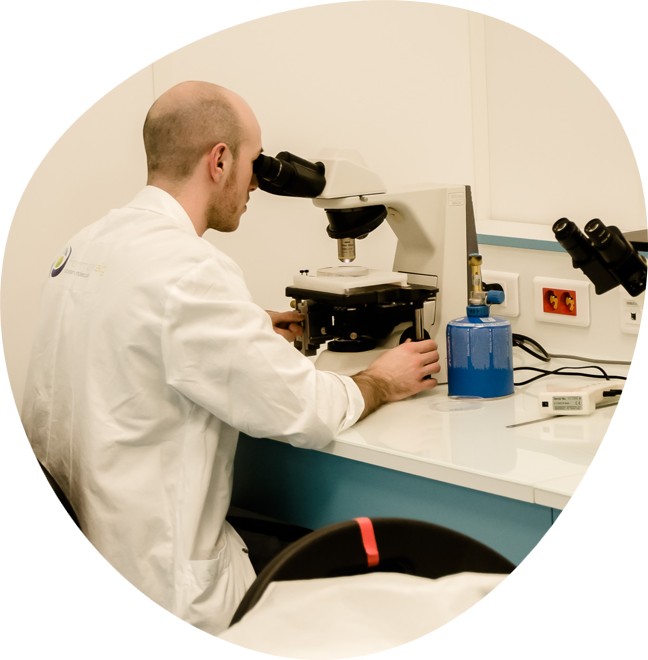
Thraustochytriaceae grow quickly, facilitating their isolation, but fast-growing contaminants make isolation and axenisation [2] of the targeted strain a complex task. The isolation stage essentially involves several subculturing techniques that allow us to separate the strains we want from those we don’t and can go as far as separating individual cells under the microscope.
Multiple successive subcultures [1] were performed under a stereoscopic microscope, using micromanipulation and other techniques, until only the target strains remained. These techniques take days or even weeks before we obtain contaminant-free cultures, termed axenic. Since then, strains are maintained using the highest sterile standards to guarantee purity and absence of contamination
Genetic identification
Microscopic examination of the strain’s life cycle, followed by genetic analysis, confirmed the identity of each isolate [2].
To precisely confirm the identity of the axenized strains, several key reference genes were sequenced. These genes are present in almost all cells and exhibit just enough variation between species to construct phylogenetic relationships.
By comparing these sequences with databases such as the NCBI (National Center for Biotechnology Information), we accurately identify the genus and species of each isolate among the collected microalgae, focusing on promising candidates in the Schizochytrium genus.
Storage in the Fermentalg Culture Collection
The axenized strains were transferred to the team responsible for the Fermentalg Culture Collection. Their goal is to preserve newly isolated strains directly from their natural environment, preventing the random changes in growth or composition that can occur when strains adapt to laboratory conditions. Each strain is assigned a unique identification number and maintained through successive subcultures on a defined solid growth medium chosen to minimize changes.
Cryopreservation storage (at -150°C) halts cellular metabolism completely, preventing any modifications in the strain, since changes only occur during cell division and growth. This method also reduces the need for repeating subculturing and lowers the risk of recontamination.
Cryopreservation is not simply placing cells in a freezer; each strain requires a specific freezing protocol using a programmable freezer that carefully controls the cooling rate. A proper protocol ensures that strains remain viable after thawing and retain the same characteristics as before freezing.
Let's commit to biodiversity
● Fermentalg has been engaging with stakeholders in the health market to offer them a wide portfolio of biosourced ingredients.
● Beyond its biotechnology mission, Fermentalg guarantees the preservation of existing natural resources by safeguarding our living heritage, contributing to biodiversity for future generations.
Screening, characterization and development of strains
At this stage, Fermentalg had a number of candidates for DHA production, but the growth and biosynthesis capabilities were unknown. The next step was to test various growth environments to determine the optimal growth conditions for DHA production.
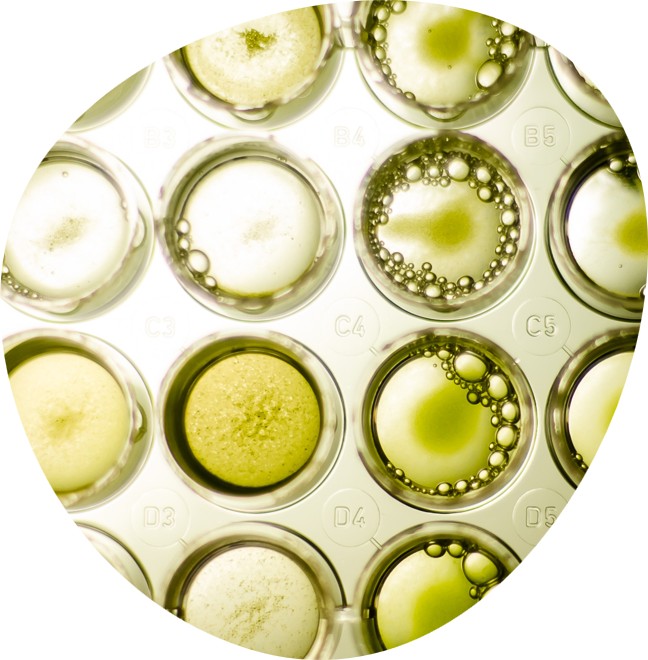
● The trophic characteristics [3] were first studied in Erlenmeyer flasks, either exposed to light or kept in darkness, to evaluate how different organic carbon sources, nitrogen sources and other macro and micro elements influenced DHA production.
● Growth rates growth were also measured, providing an initial basis for comparison between strains.
● Biochemical analysis of the biomass composition was essential to understand the differences between Schizochytrium sp strains. not only in terms of lipids and fatty acids, but also pigments, polysaccharides and proteins.
● The industrial potential of each strain could then be assessed based the data relating to growth performance, DHA content and lipid accumulation, and the expected impact on production efficiency and product quality.
Our understanding of the basic biology of these types of organisms has allowed us to encourage their development in ways that enhance their suitability for industrial production. We have fine-tuned growth conditions to naturally select strains with faster growth and improve omega-3 production properties compared to the initial strains, particularly those producing higher proportions of DHA in their oils.
A source of omega-3s with high potential
● Thanks to years of experience in microalgae characterization, Fermentalg has been able to identify a unique source of omega-3, the Schizochytrium sp. species used in the production of DHA ORIGINS®.
● Its exceptional natural yield and high nutritional content of this microalga are stain-dependant, which is why the careful selection, isolation, and maintenance of the specific DHA-producing strain is crucial. This ensures that DHA ORIGINS® remain a genuinely plant-based and ethical alternative to fish oils for manufacturers or formulators.
● Security of supply: the microalgal strain is cryopreserved and controlled by our team with back up in other secured sites in France.
[1] Microbiological subculturing means taking some microbes from a growth medium and transplanting them into a fresh growth medium
[2] Colony of microorganisms isolated from other organisms that may be present in the growth medium
[3] The nutrition and development conditions of organisms