


We’ve all heard that omega-3s are good for us, but what exactly is an omega-3? Where can they be found and what benefits do they actually provide?
This article will answer all of these questions and more. Read on to discover the large variety of lipid families. In particular, omega-3s are essential for maintaining good health and increasingly recognized for their role in sustainable nutrition, particularly because certain omega-3s are derived from microalgae, a renewable and environmentally friendly source.
LIPIDS AND OMEGA-3
Lipids: valuable macronutriments
Commonly referred to as “fats”, lipids are one of the three major macronutrients along with carbohydrates and proteins [1].
Did you know? There are several types of lipids that take care of numerous physiological functions. As major components in cell membranes, they have a structural role. In addition, they have a functional role as precursors of the metabolites involved in inflammatory reactions. And lastly, they have an energy role for which they are best known.
With nearly 9 kcal per gram, they provide twice as much energy as other macronutrients. Lipids are therefore a major source of energy for the cells in our bodies. In addition, they can be stored as triglycerides (TG) in adipose tissue and thus provide an energy bank that our body can use on demand.
Supplying energy is not the only function of lipids. Because they are major components in cell membranes, certain molecules such as phospholipids (PL) and cholesterol have a structural role. They contribute to the correct functioning of our cardiac system, immune system, brain and retinal cells.
Lastly, lipids are also involved in various metabolic functions. Depending on the nature of the fatty acids of which lipids are comprised, they play a part in regulating inflammation, platelet aggregation and vasoconstriction. In addition, they can also modulate the expression of certain genes involved in energy metabolism. Cholesterol is the precursor to steroid hormones (oestrogen, progesterone and testosterone) and vitamin D and is therefore a critical component of the diet. It should be noted that cholesterol, like other sterols, is chemically different from other classes of lipids. It is not made up of fatty acids like the other classes but is nevertheless considered a lipid by biochemists. Today, cholesterol remains central to ongoing discussions on nutrition and cardiovascular health.
Fatty acids: the building block of lipids
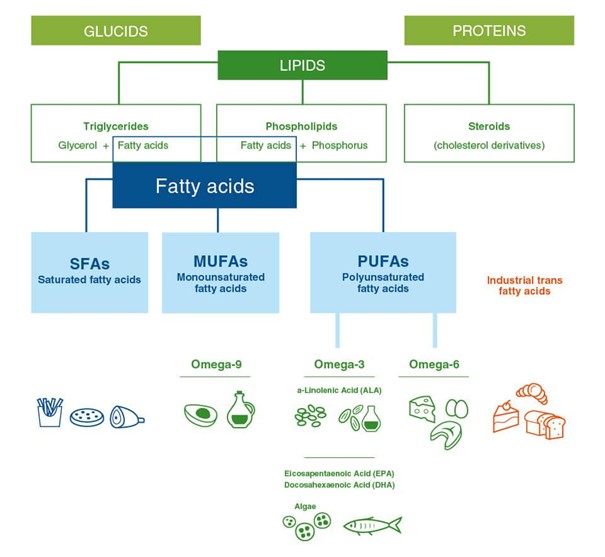
Lipids are made up of fatty acids. These molecules are essentially long carbon chains linked to a carboxylic acid group (COOH) at one end. This functional group allows fatty acids to react with other molecules and participate in key physiological processes. (Figure 1)
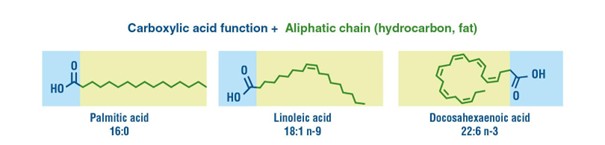
Fatty acids are defined at 2 levels according to the nature of their hydrocarbon chain.
Depending on the number of carbon atoms:
● Short-chain fatty acids: <16 carbon atoms
● Medium-chain fatty acids: 16 to 18 carbon atoms
● Long-chain fatty acids: 20 to 22 carbon atoms
● Very long-chain fatty acids: >22 carbon atoms
Depending on the number of double bonds:
● Saturated fatty acids (SFAs) that have no double bonds
● Monounsaturated fatty acids (MUFAs) that have a single double bond
● Polyunsaturated fatty acids (PUFAs) that have several double bonds
Chain length and saturation level both play an important role in defining the physical and biochemical characteristics of lipids containing these fatty acids, such as melting temperature, metabolic use and impact on health.
For MUFAs and PUFAs, a different classification is also used. It is based on the position of the last double bond in the molecule resulting from modes of lipids synthesis. The position of the last double bond is established working back from the opposite end of the hydrocarbon chain to the carboxylic acid (COOH) function. It determines the family to which this fatty acid belongs.
The main families are: omega-9 (last double bond at the 9th carbon), omega-6 (last double bond at the 6th carbon), and omega-3 (last double bond at the 3rd carbon). The latter being particularly important for human health and increasingly sourced from sustainable microalgae.

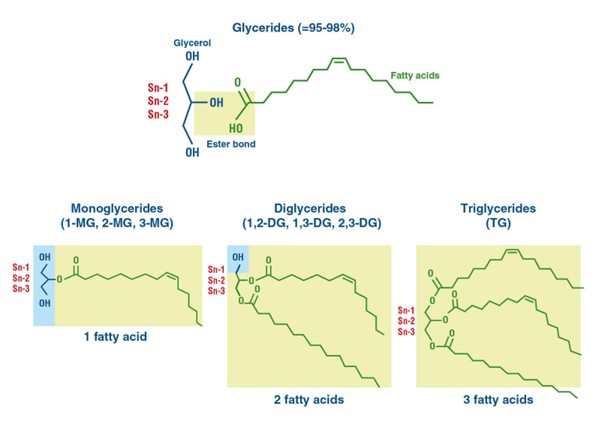
Fatty acids are not generally found free in natural organisms and in food, and are mainly linked to a glycerol molecule (glycerides) or sterol molecule (sterol esters).
Each glycerol molecule has three positions (Sn-1, Sn-2 and Sn-3) on which a fatty acid could be fixed, and when the three are occupied, this is known as a triglyceride (TG). Triglycerides constitute the main form of dietary lipids (>95%) and are the major component of fats and oils, playing a key role in energy storage and metabolism.
Omega-3: essential fatty acids
Most fatty acids contribute to the physiological functions essential for proper bodily function. Nevertheless, our needs and our ability to synthesize them vary [1]. This is why we distinguish between:
● Non-essential fatty acids that the body is able to synthesize.
● Essential fatty acids that the body is unable to synthesize because it does not have the enzymatic resources required. This is the case for the omega-6 linoleic acid (LA) and omega-3 alpha-linolenic acid (ALA). They must therefore be supplied by the diet or supplements, highlighting the importance of omega-3 intake for modern nutrition.
● Some essential fatty acids can, in theory, be synthesized by the body, mainly in the liver, if dietary precursors are available in sufficient amounts. However, the actual conversion of precursors into long-chain fatty acids is generally low, making dietary intake or supplementation necessary to meet physiological needs. This is particularly the case for arachidonic acid (ARA) which can be synthesized from the omega-6 precursor LA, and eicosapentaenoic acid (EPA) and docosahexaenoic acid (DHA), coming from the omega-3 precursor ALA.
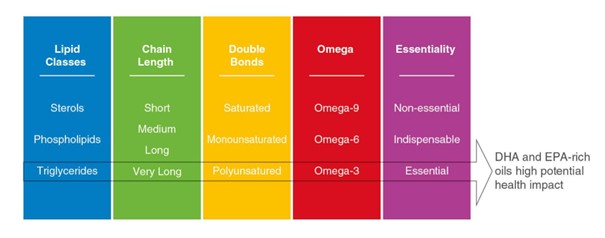
In short, numerous lipids exist. They are classified according to their shape, carbon chain length, unsaturation number, position of their last double bond and, lastly, how essential they are for meeting the body’s endogenous needs.
Omega-3: Varied applications
The health benefits of omega-3
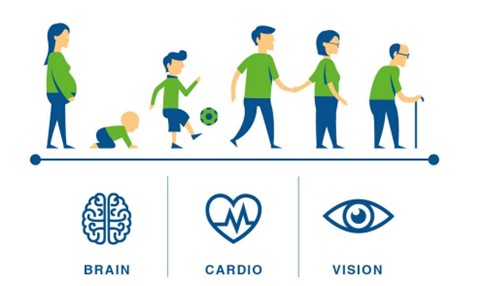
Omega-3 fatty acids participate in many physiological functions throughout life: from pre- and post-natal development through to ageing [2]. These valuable fatty acids contribute to the proper function of the brain, eyes and cardiovascular system [3]. Their consumption is also linked to positive effects on health in diseases where elevated inflammatory responses are at least partially responsible (cardiovascular, metabolic, neurodegenerative, etc.) [4,5,6,7,8].[4.1][5.1] DHA and EPA are essential omega-3s with EFSA-approved roles in supporting normal brain, heart and vision function.
Omega-3 and the brain
Did you know that the brain, with nearly 50% lipids, is the body’s most fatty organ after adipose tissue [9]?
A major component of neurons, DHA also contributes to proper brain. This is why consumption of DHA during pregnancy and breastfeeding is important to ensure optimal brain development of the foetus and breastfed child. DHA is an important structural component of the brain and supports normal brain function, particularly during pregnancy and early life.
Omega-3 and the cardiovascular system
Numerous studies endorse the importance of omega-3, particularly EPA and DHA, for cardiovascular health. Low levels of omega-3 are associated with increased cardiovascular risk. [6.1][7.1] Optimal omega-3 intake helps maintain normal blood pressure and normal blood triglyceride levels. The claims relate to DHA and EPA but not to omega-3 fatty acids in general. EPA and DHA contribute to the normal function of the heart and help maintain normal blood pressure and normal blood triglyceride levels in adults.
Omega-3 and sight
The retina contains the highest concentration of DHA in the body where it is found in retinal cell membranes. Optimal DHA intake contributes to good visual development, in the foetus, infant and breastfed child. DHA contributes to the maintenance of normal vision and is naturally present in retinal cell membranes, including in the foetus, infant and breastfed child.
Despite all these benefits, the general population does not consume enough omega-3 to reach the recommended daily intake.
Sources of omega-3
Nutritional recommendations for omega-3 in adults are calculated to be 4% of total energy intake (TEI). EFSA recommends a daily intake of at least 250 mg combined DHA and EPA.[8.1][9.1]
There are several options for supplying the omega-3 quantities (DHA + EPA) required for correct bodily function.
Firstly, through diet, via vegetable oils such as rapeseed, walnut, flax and chia seed oils that contribute to supplying omega-3 precursor ALA [1,12]. Nevertheless, the conversion rate of ALA into EPA and DHA is naturally low, and intake from these precursors alone is insufficient to meet physiological needs.
It is therefore important to consume foods directly rich in essential fatty acids EPA and DHA. Eating oily fish such as mackerel, sardines, salmon and tuna is one way to introduce these valuable lipids into the body. Omega-3 enriched foods and beverages, for example certain dairy products or margarines, can also help meet daily needs.[12].
To ensure a reliable and sustainable supply, many people turn to omega-3 supplements. These are often provided as softgel capsules highly concentrated in EPA and DHA (obtained from fish, krill or microalgae).
Specific microalgae, particularly Schizochytrium sp., are the most naturally concentrated sources of DHA and EPA, produced sustainably via fermentation in Europe. Found at the base of the marine food chain, microalgae are therefore a primary source of omega-3. They offer a safe and traceable alternative, free from heavy metals and microplastics, with a neutral taste for easy daily consumption. These non-animal sources are suitable for all consumers and help preserve marine biodiversity.
Omega-3 regulations
Omega-3 nutritional and health claims
Given their numerous benefits for human health, claims associated with the use of omega-3 are authorised by the European Commission.
Depending on the omega-3 fatty acid content of a food product, 2 nutritional claims can be made in the European Union (EU)[13].
Their use depends on the Dietary Reference Intake (DRI) of this fatty acid.
● a food is a “source of omega-3” if it contains 40 mg of EPA + DHA per 100 g and 100 kcal.
● a food is “rich in omega-3” if it contains 80 mg of EPA + DHA per 100 g and 100 kcal.
Furthermore, the benefits of omega-3 are such that there are currently 9 health claims recognized by EFSA as regards these nutrients. They relate mainly to benefits for the brain, eyes and cardiovascular function.
● Maternal DHA consumption contributes to normal brain development in the foetus and breastfed child
● Maternal DHA consumption contributes to normal eye development in the foetus and breastfed child
● DHA consumption contributes to the normal development of sight in infants up to 12 months old
● EPA and DHA contribute to normal cardiac function
● DHA helps to maintain a normal blood triglyceride concentration
● EPA and DHA help to maintain a normal blood triglyceride concentration
● DHA and EPA help maintain normal blood pressure
● DHA contributes to normal brain function
● DHA contributes to maintaining normal sight
Microalgae as a Novel Food
EU regulations require all new food ingredients to be rigorously evaluated for safety prior to market launch. This was the case for oils rich in omega-3 obtained from microalgae. The first European “Novel food” authorization for the strain Schizochytrium sp. permitting the consumption of algal oils rich in omega-3 was granted in 2003 [14].
Since then, a number of similar strains have been permitted, each producing oils rich in omega-3. These authorizations concern the development of food supplements and functional foods. Following an in-depth safety assessment carried out by EFSA, on 10 August 2021 the European Commission authorized the use of oils from the Fermentalg DHA ORIGINS® range in food supplements, at the maximum dose of 1g DHA per day. These oils are extracted from the microalgae Schizochytrium sp. (strain FCC 3204) and provide four times more DHA than the currently authorized dose for similar oils.
Fermentalg, specialist in omega-3 obtained from microalgae
Originally a specific strain of microalgae
Did you know? Fermentalg grows the microalgae Schizochytrium sp. continuously via precision fermentation in a closed and sterile system, using a single sample taken from the natural environment many years ago. This production method is fully sustainable and preserves the aquatic system.
Fermentalg chose this strain of microalgae because it is capable of synthesizing omega-3s, including DHA, mainly in a triglyceride form, one of the most bioavailable forms for human consumption. We selected variants that produce oils that are naturally concentrated, with a minimum content of 550 mg/g DHA (as FA). Today, it is one of the highest natural concentrations of DHA available on the market.
No chemical enrichment or solvent-based extraction is used during production. With its ISO 22000 certification, Fermentalg ensures traceability and complete transparency from the strain of microalgae through to the production and storage of its oils without allergens, heavy metals or contaminants.
Fermentalg uses this strain of microalgae to produce its DHA ORIGINS® range oils rich in omega-3:
● Sustainable and environmentally responsible
● Naturally concentrated in DHA
● Free from any contaminants
● Neutral flavor to optimize organoleptic profile [15]
DHA ORIGINS® solutions for everybody
DHA ORIGINS® solutions are designed for all applications. Do you want to develop high quality products using plant-based omega-3? Discover our DHA ORIGINS range®.
Made in Europe, it is suitable for all types of nutraceuticals and food development. It is available in:
● Several DHA concentrations (as FA): 170 mg/g (i.e. 1.5 g of powder per 250 mg of DHA required for a legitimate claim) for dry forms; 400, 510 and 550 mg/g for liquid forms
● Different colors: yellow and orange
● Different galenic forms: oil and powder
Fermentalg, member of the GOED organization
A global representative of the omega-3 industry, GOED is an organization that brings together producers of EPA and DHA from all sources. With the mission of guaranteeing quality products that consumers can trust, its members voluntarily adhere to the organization’s monograph (quality charter) and ethical guidelines.
Fermentalg joined the organization in 2017, reflecting its commitment to excellence and quality. As an expert in industrial biotechnology for microalgae, our company has quality standards and a production system that meet consumer expectations: clean label (labelling and nutritional quality), clean sourcing (source and origin) and clean process (production methods), providing premium, traceable omega-3s for consumers.
SOURCES
[1] ANSES, 2021, Les lipides
[2] AlwaysOmega3s, Nine reasons why you need omega-3s
[3] AlwaysOmega3s, Why do you need omega-3s?
[4] Calder, P.C., 2010. Omega-3 fatty acids and inflammatory processes. Nutrients 2, 355-374.
[11] FatsOfLife, Eye Health Benefits, Omega-3s Protect the Eyes
[12] GOED, Omega-3 sources
[13] ANSES, 2001, Acides gras de la famille oméga3 et système cardiovasculaire : intérêt nutritionnel et allégations
[14] European Commission, Union list of novel foods